
A responsible approach to commercial refrigeration
Based in Pompignac, near Bordeaux, FCCI has been supporting players in the retail, food processing and collective catering sectors since 1987. In 2016, the company embarked on a new initiative to anticipate regulatory changes under the F-Gas Directive and offer its customers sustainable and long-lasting solutions. Specialising in commercial and industrial refrigeration, FCCI takes a responsible approach to refrigeration, based on three priorities: reducing the carbon footprint of installations, securing equipment and simplifying its operation. This vision is fully in line with the need to limit direct emissions from leaks while maintaining a high level of reliability for operators.
FCCI is therefore gradually moving away from centralised systems with high refrigerant charges for commercial refrigeration in favour of indirect systems using heat transfer fluids, which they already have expertise in within the industry.
This design allows the refrigerant to be confined to the technical room, drastically reducing the charges in sales areas and limiting the length of refrigeration piping.
“Providing maximum cooling capacity with minimum refrigerant is our guiding principle,” summarises Sylvain Fouchard, former director of FCCI.
The refrigeration systems are based on several independent low-charge units rather than a single central unit. This modularity improves service continuity with redundancy in the event of a unit failure, as the others take over. It also facilitates maintenance and reduces technicians’ exposure to fluids.
In January 2026, manager Sylvain Fouchard handed over the business to a new generation of partners who shared his philosophy. The ambition remains unchanged: to offer energy-efficient, secure refrigeration solutions that combine energy performance, environmental responsibility, within operational constraints.
Greenway® Neo N, a key driver of CSR
Bio-based Greenway® Neo N heat transfer fluid is the solution chosen for indirect installations developed by FCCI. It distributes cooling to cold rooms and refrigerated cabinets. Compatible with food environments (NSF registered), more stable over time and less viscous than conventional monopropylene glycol, it improves hydraulic performance and reduces pumping consumption.
“The first store to use Greenway® Neo N was a 5,000 m² Leclerc hypermarket. Since then, we have fitted out numerous stores with smaller sales areas in line with market trends. After several years of operation, no significant deterioration of the fluid or the networks has been observed. Some sites are still operating today with the original heat transfer fluid after nearly ten years, proof of the solution’s durability,” emphasises Sylvain Fouchard.
Reliability and safety at the heart of the installations
The systems developed by FCCI are based on independent units, short circuits and standardised components, enabling rapid maintenance and high availability of parts. This approach reduces emergency call-outs and facilitates troubleshooting, even at night, while ensuring safety for operators.
Monitoring of hydraulic parameters (pressures, temperatures, flow rates) also enables early detection of abnormalities and anticipation of potential leaks, further enhancing overall reliability.
For cooling, FCCI initially relied on proven refrigerants such as R-513A and R-448A before gradually integrating very low GWP A2L refrigerants such as Solstice® L40X (R-455A) and R-454C. This transition is taking place without any technological disruption, using simple, modular and easy-to-maintain machines.
Practical examples of achievements
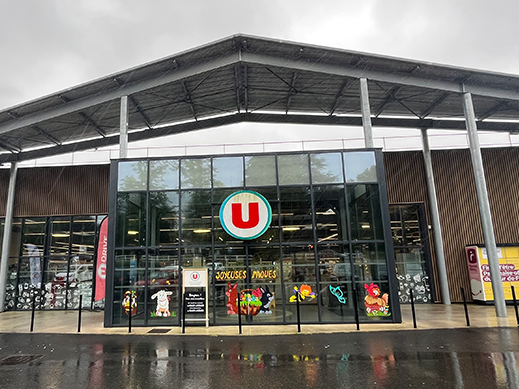
The Super U in Léognan
Commissioned several years ago, the Super U installation in Léognan has provided practical feedback on the reliability of the indirect architectures developed by FCCI. Used daily since its commissioning, it has demonstrated over time the robustness of the combination of low refrigerant charge and distribution via Greenway® Neo, both in terms of energy performance and maintenance, as well as service continuity.
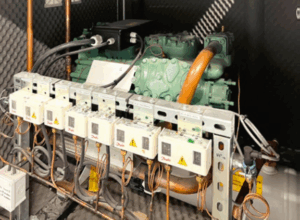
For this local supermarket, FCCI deployed a complete indirect architecture for medium temperature refrigeration with two 50 horsepower Bitzer units, each supplying a plate heat exchanger. Each circuit operates on R-513A with a charge limited to approximately 45 kg of fluid per unit, i.e. a cooling capacity of around 70 to 80 kW for a minimum charge. Two buffer tanks provide thermal inertia, then secondary pumps distribute Greenway® Neo N to all cabinets and cold rooms via several hydraulic networks.
The central kitchen of Saint-André
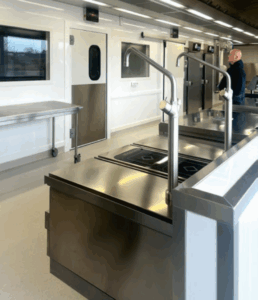
The more recent Saint-André central kitchen is an example of the new generation of FCCI facilities, incorporating very low GWP refrigerants and even lower charge sizes from the design stage onwards.
This project capitalises on the experience gained at the first sites to go even further in terms of energy efficiency, health and safety, and ease of operation.
The central kitchen is equipped with seven medium temperature cold rooms powered by an indirect Greenway® Neo N circuit. Cooling is provided by two Bitzer Ecolite condensing units operating on R-454C (A2L), with a charge of only about 15 kg of refrigerant per unit. The refrigerant is completely confined to the technical room, while the chilled fluid is distributed by the hydraulic network to the evaporators in the rooms.
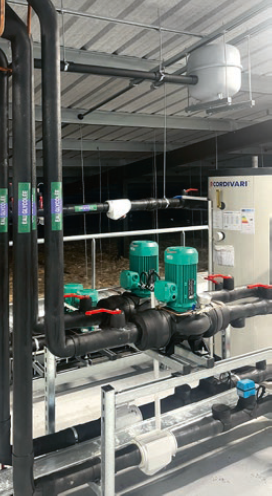
The installation includes two plate heat exchangers, a buffer tank of approximately 1,000 litres, and primary and secondary pumps. This architecture greatly limits the presence of refrigerant in food preparation areas, reduces health risks and simplifies maintenance operations. Low temperature cooling is handled separately using direct expansion with R-455A, ensuring robust and stable operation. The system offers excellent thermal performance, simplified maintenance and safe operation, perfectly suited to the constraints of commercial catering

From left to right: Julien Forgues, Teddy Rubio, Cyril Village, Clément Lambert, Sylvain Fouchard