

Article written by Mohammed YOUBI IDRISSI, Technical Manager for the EMEA
region at Solstice Advanced Materials.
Major European retail chains are at a crossroads. Having enjoyed decades of extensive growth, they now face a fourfold challenge:
- To reduce their operating costs against a backdrop of inflationary pressure;
- To meet the demands of consumers who are increasingly discerning about product quality, traceability and environmental impact;
- To accelerate their energy transition to comply with increasingly stringent regulations;
- To adapt to climate change (repeated heatwaves, water shortages, flooding, etc.) which affects not only energy-related equipment at the point of sale – notably refrigeration and HVAC systems – but also consumer behaviour.
In this context, the transformation of the retail outlet is no longer a strategic option; it is an operational necessity.
Breakdown of energy consumption in the retail sector
Refrigeration and HVAC account for up to 70% of energy consumption in a modern retail outlet.
The shop of 2036: three pillars of transformation
ENERGY EFFICIENCY
- Low GWP cooling
- AI-powered predictive control
- Solar power generation
- Heat recovery
- Vehicle charging
CUSTOMER EXPERIENCE
- Social connection
- Local retail
- Product traceability
- Nutrition and health
- Hybrid services
PERFORMANCE AND DATA
- IT and Building Management Systems
- Optimised logistics
- Sustainable financing
- Environmental benefits
- Hybrid models
Economic performance and environmental transition are mutually reinforcing.
Energy: the key driver of competitiveness
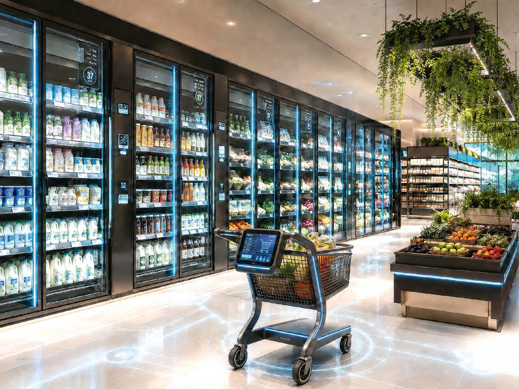
The energy challenge is at the heart of priorities. Food refrigeration and air conditioning systems alone account for 50 to 60 per cent of a retail outlet’s energy bill. The transition to low-climate-impact refrigerants, particularly eco-efficient HFO-based solutions, the predictive management of systems using artificial intelligence, and the recovery of waste heat to meet local heating needs are all available levers.
However, their roll-out remains uneven: whilst newly built supermarkets incorporate these technologies from the design stage, existing, often ageing, facilities are struggling to make the transition due to a lack of suitable financing models. Energy performance contracts (EPCs) and third-party financing solutions are emerging as promising solutions to overcome this
barrier.
Business models undergoing a major overhaul
The business models of tomorrow may differ in form but converge in substance. The generalist hypermarket is losing ground to more specialised formats: the optimised discounter appeals through its prices, the local mini-market through its convenience, and the specialist shop through its expertise. In this fragmented landscape, one constant stands out: the physical shop must offer what the digital world cannot: human interaction and social connection, sensory discovery, and personalised advice. The retailers that succeed are those that have managed to redefine their purpose beyond the simple commercial transaction, turning the point of sale into a place of life, service and experience.
The rise of local shops illustrates this trend. Long neglected in favour of out-of-town supermarkets, the neighbourhood shop format is experiencing a marked resurgence in interest, driven by changing urban lifestyles and the quest for a reduced carbon footprint.
For retailers, this means rethinking last-mile logistics, optimising product ranges to suit local catchment areas, and integrating new services – such as parcel lockers, click-and-collect and home delivery – into spaces that are often limited in size.
Refrigeration systems are also evolving!
We are also witnessing a genuine revolution in refrigeration systems, with the old model based on two centralised units (medium and low temperature) giving way to new, more decentralised or semi-distributed systems using high-performance refrigerants with very low GWP (e.g. R-455A), which offer energy savings and operational resilience.
Furthermore, the heatwaves that Europe experienced during the summer of 2026 showed that some systems struggled. This is by no means a trivial observation, as these systems were most likely originally designed on the basis of a design outdoor temperature of around 32°C; a benchmark inherited from a climate in which certain regions were not expected to experience heat peaks of up to 42°C.
The shop as a generator of environmental value
Beyond reducing energy consumption, the shop of the future is set to become a positive force in the environmental transition. The installation of rooftop solar panels, the provision of charging points for electric vehicles, smart food waste management and the repurposing of unsold stock: these are all initiatives that transform the retail outlet into a genuine hub of sustainable services for its local area.
Building regulations are accelerating this transformation. But they also present an opportunity: retailers who anticipate these changes position themselves favourably with consumers who value environmental commitments, whilst ensuring regulatory compliance at a lower cost. These pioneers are not spending money out of idealism. They are safeguarding the value of their assets, maintaining their insurability, protecting their staff and upholding their carbon commitments against disruptions that the climate, or a weakened electricity grid, could cause at any moment.
The rest will pay twice: once for the cost of the disaster, and a second time for the cost of emergency adaptation, which is always more expensive and less effective. And in the meantime, the tonnes of CO2 emitted as a result of a failure to plan ahead will also have to be accounted for.
The shop as a climate refuge
The shop of tomorrow is evolving, adapting and emphasising its social role. Here are two examples:
- In late 2024, during the catastrophic floods that struck the Valencia region in Spain, a local branch of a specialist retailer – built ten years earlier with raised stock levels and preventive measures in place – became a refuge within a matter of hours. Hundreds of customers, visitors and people trapped in the shopping area were sheltered there for over twenty hours. The retailer served as a base for the emergency services.
- In response to the increasing frequency of heatwaves across France, several retailers announced in July 2026 the launch of the ‘Escale Fraîcheur’ scheme. Each shop or shopping centre taking part in this initiative adapts its facilities according to its infrastructure and logistical capabilities. Depending on the layout of each premises, the scheme may include a cooled or air-conditioned area, seating, access to drinking water, and assistance or guidance from staff on site.
Data and artificial intelligence: the new drivers of performance
The transformation of the point of sale is also a data revolution. Connected sensors, building management systems (BMS) and predictive analytics platforms now make it possible to manage energy consumption in real time, anticipate breakdowns, optimise stock levels and personalise the customer experience. Artificial intelligence is no longer a distant prospect: it is already at work in logistics warehouses, central purchasing organisations and, gradually, in the shops themselves.
The real question is no longer one of technical solutions, which already exist and are numerous. It is one of the pace of roll-out and the funding models that will enable all retailers, regardless of their size or level of digital maturity, to sustainably reconcile economic performance with environmental transition.
The winners of the coming decade will be those who have turned this constraint into a competitive advantage.